C:\ARCHIVE\R_002_RUKO\case_study.txt
Ruko
A warning people believe, at the second it matters.
Scammers rush parents into paying. Ruko is a safety layer inside a payment app. It pauses the payment, says plainly what will happen to their money, and puts family one tap away.
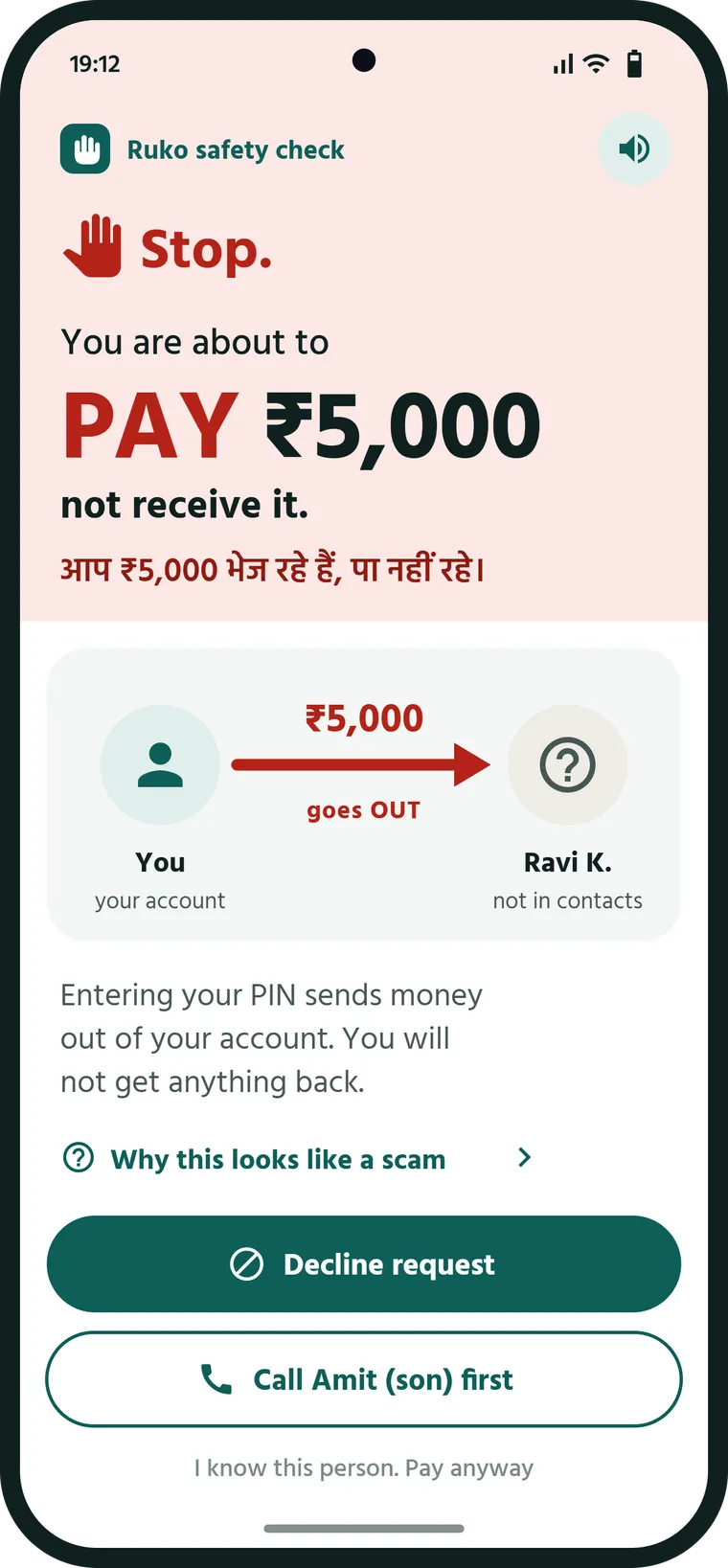
Ruko is Hindi for “stop”. It’s a working name.
01TL;DR
Parents knew the rules. Under a scammer’s pressure they forgot them.
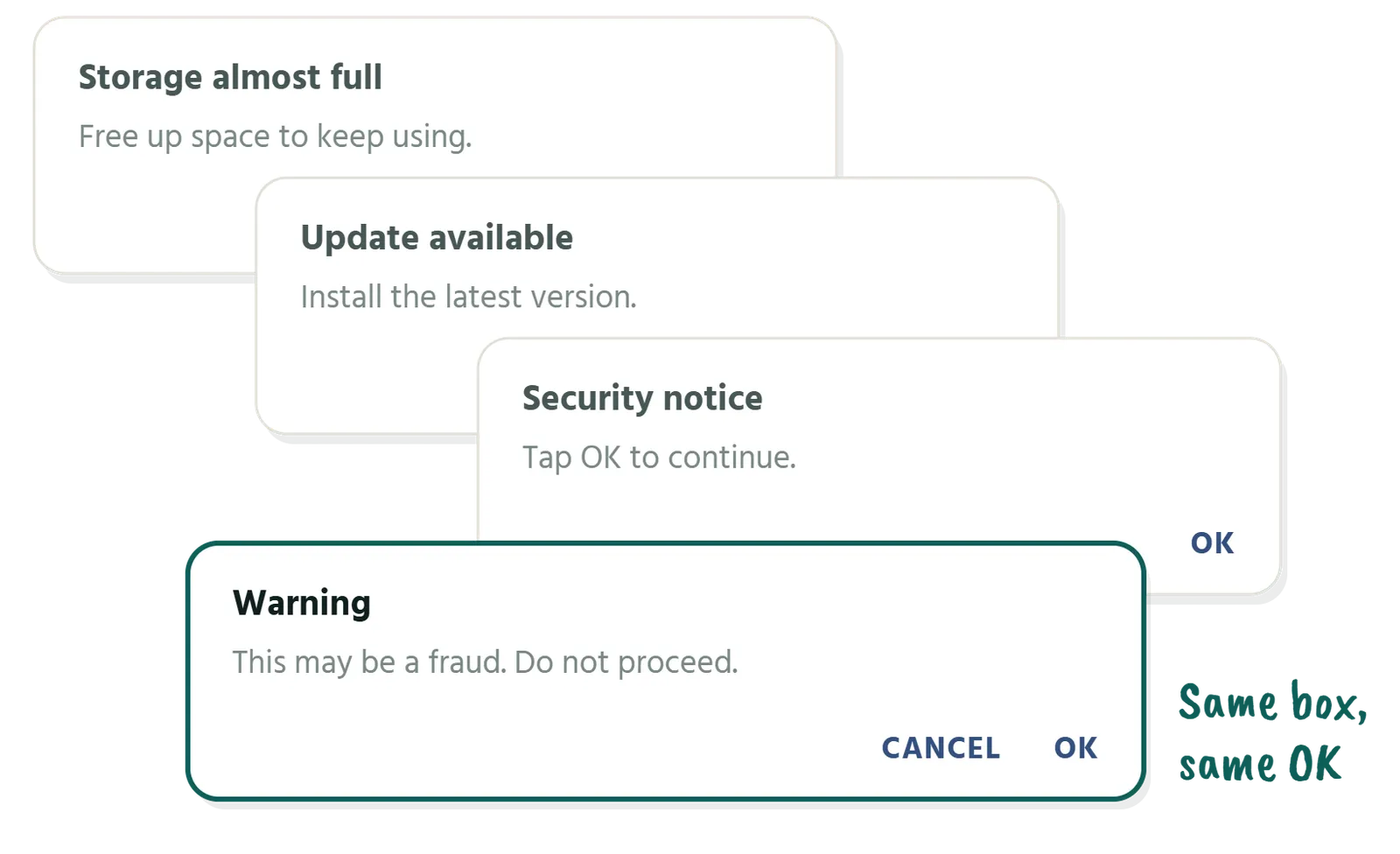
Scammers keep parents on the phone and rush them. Today’s warnings look like every other pop-up, so they get tapped away.
6 interviews with relatives aged 48 to 68 about their scams and who they trust, plus a test of three warning messages.
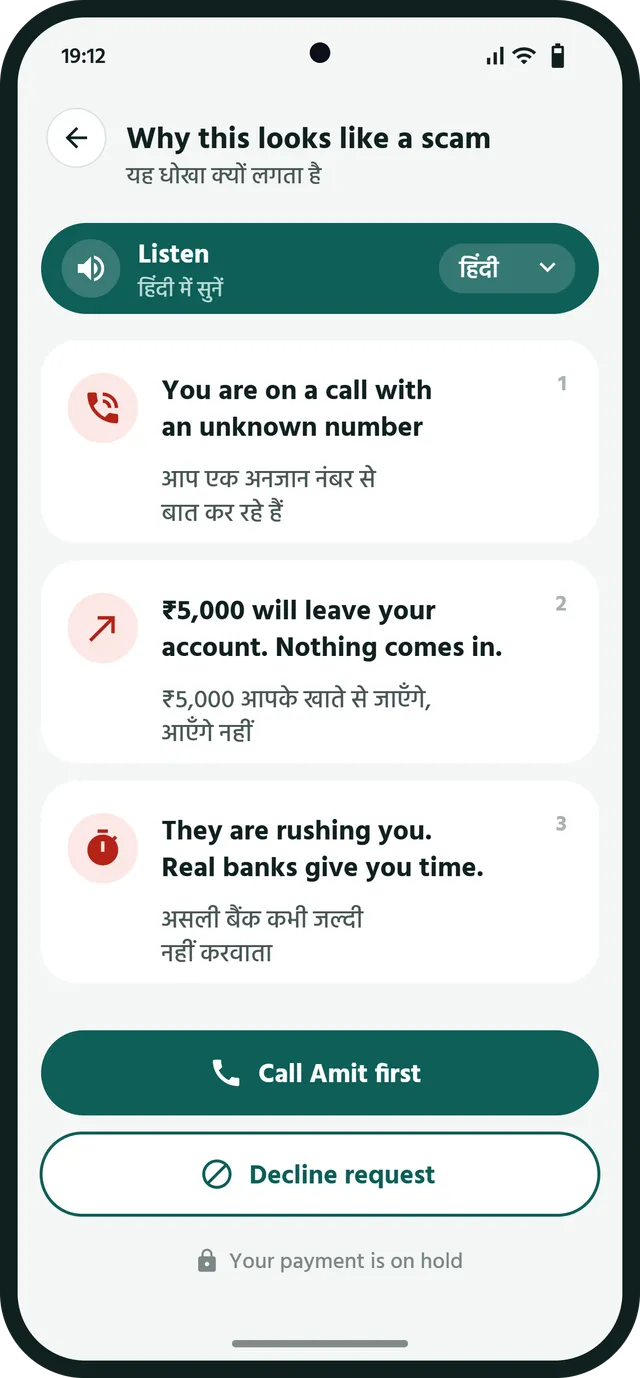
A stop screen that names the money, explains why in their language, and offers one tap to call family.
If this exact message had popped up on my screen last year… my ₹4,000 would still be in my pocket today!
02The scene
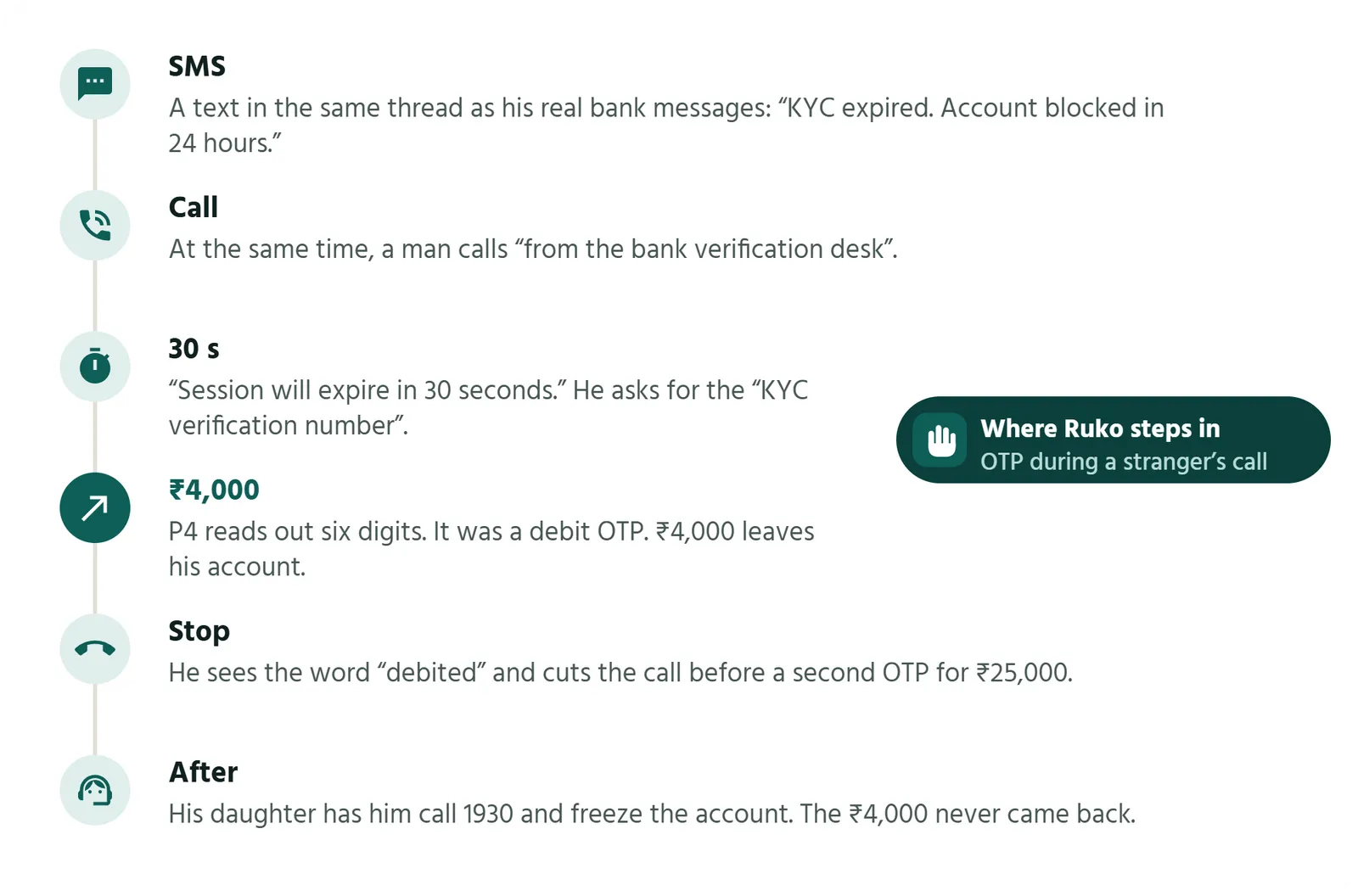
He knew banks never ask for an OTP. With 30 seconds on the clock, he read one out.
In that moment of panic, you forget the rule that ‘banks never ask for OTP.’
03Method
Six conversations with family aged 48 to 68: close enough to be honest, too close to be neutral.
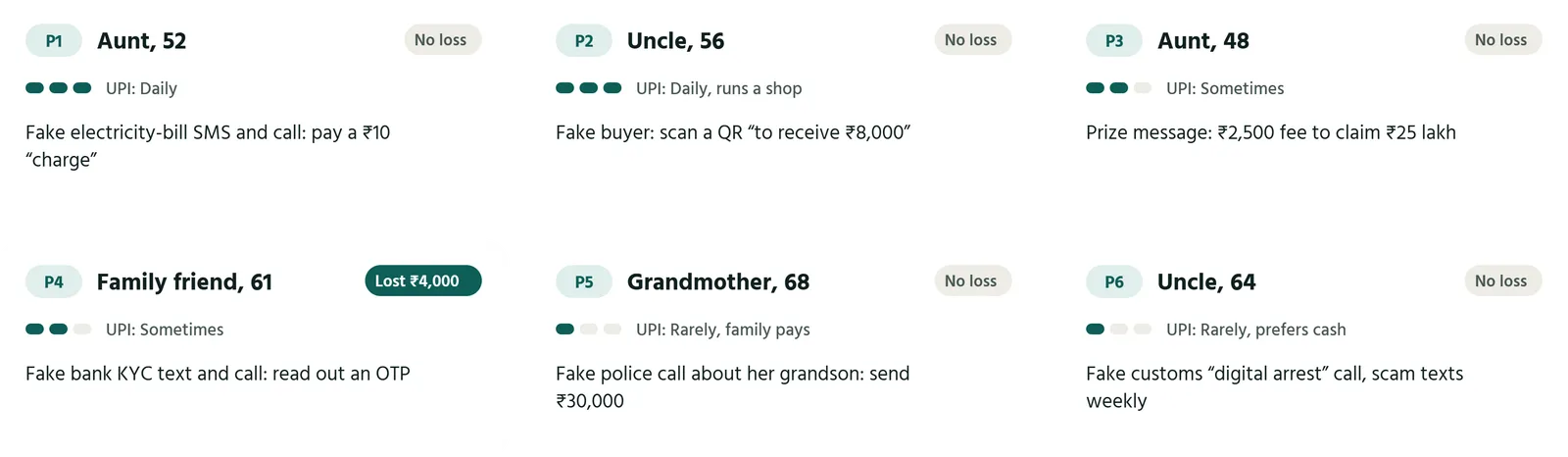
30-minute talks in Hindi and English about real payments and real scams, then three test warnings read aloud (in Hindi for P5).
They told me things they’d never tell a stranger, like P4’s loss. But they come from one family circle, found by referral, and they may have been kind to my ideas.
04Scams they met
All 6 had met a scam. Fake “account blocked” texts and fake officers led.
Out of 6. One scam can carry several patterns.
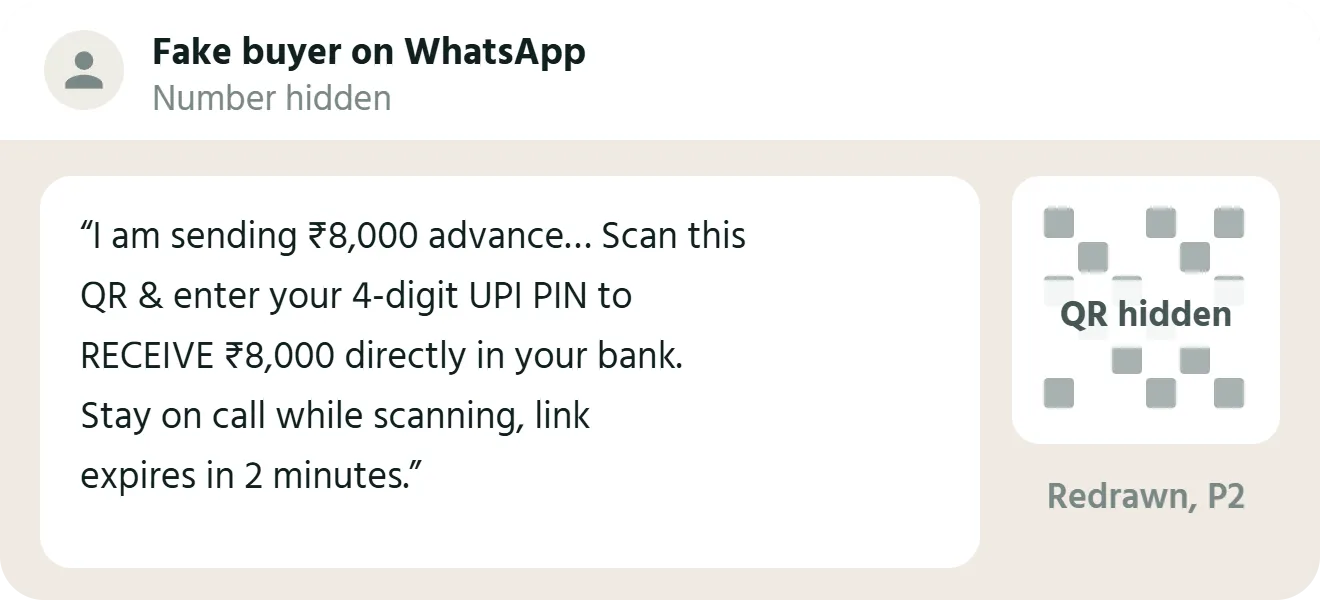
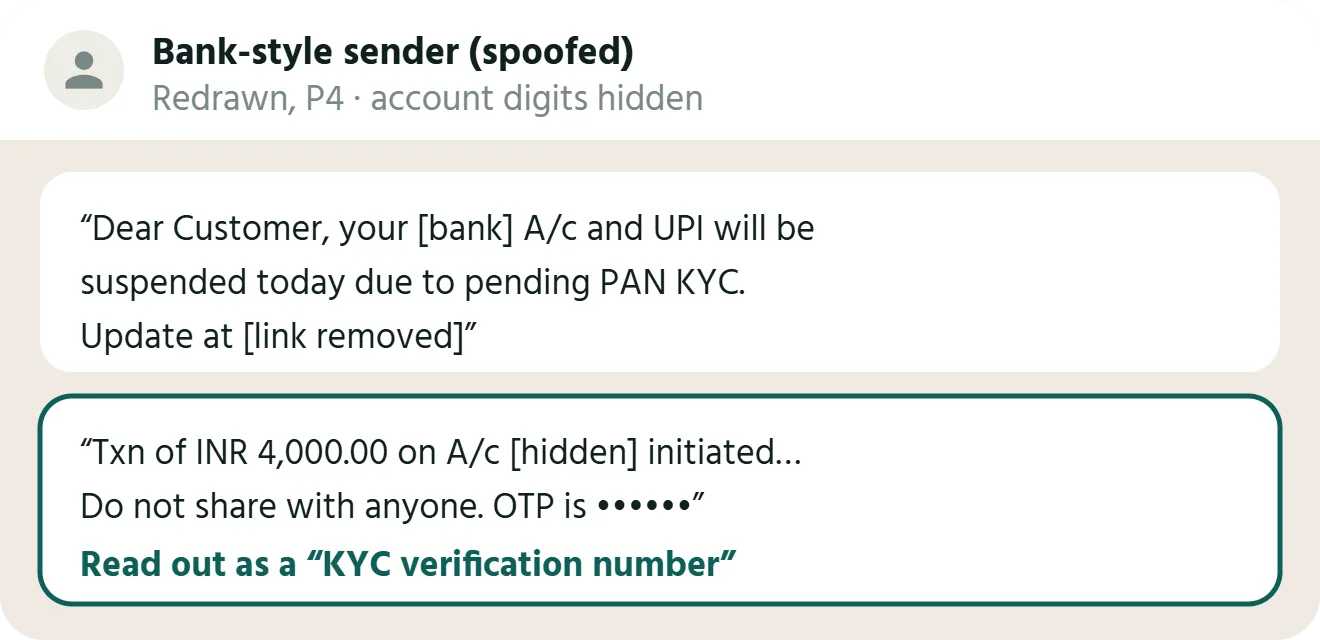
Every scam borrowed something real
An official look
“an army uniform photo… makes you respect the person” (P2)
A ticking clock
“Sir session will expire in 30 seconds” (P4)
Staying on the call
“He stayed on the phone line continuously” (P2)
Timing from real life
“just two days before, your uncle had paid the bill online” (P1)
Renaming the risky step
A debit OTP, called a “KYC verification number” (P4)
Keep it secret
“don’t tell anyone in your neighborhood” (P3)
05Who they trust
6 of 6 trust family first. The app is trusted only when it explains itself.
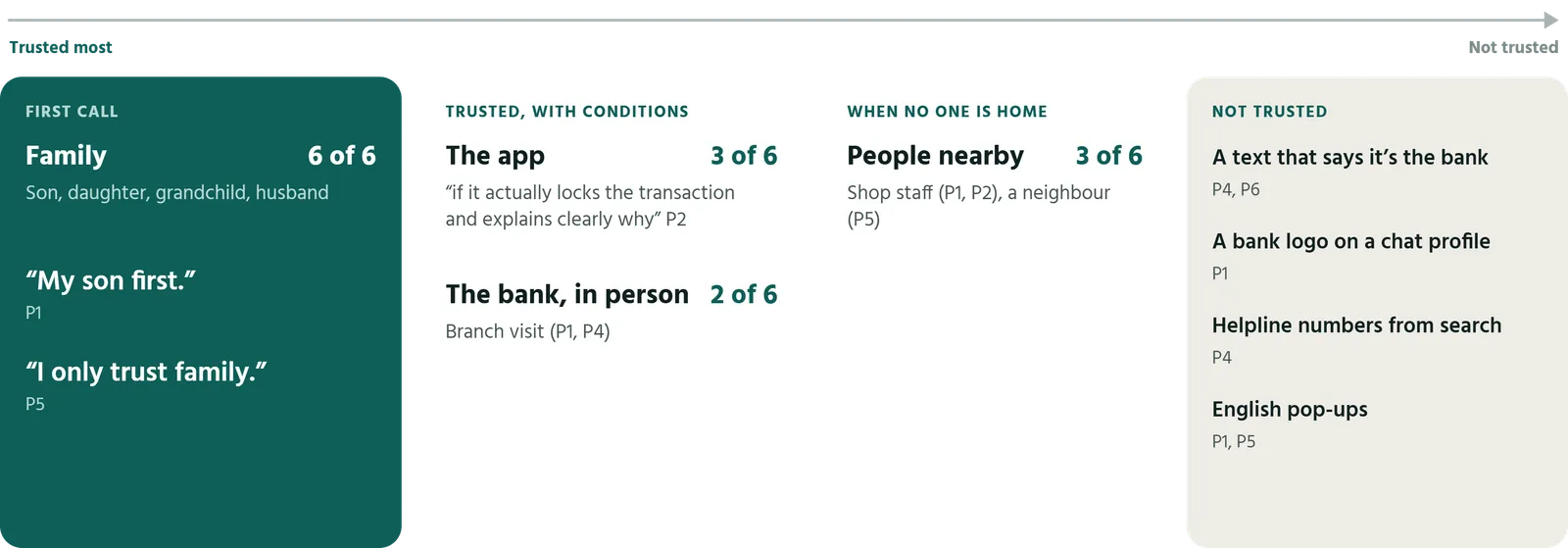
I don’t know what ‘the app’ or ‘the phone’ is thinking, I only trust family.
06What I got wrong
I thought the gap was knowing the rules. It was remembering them under pressure.
My assumption: people fall for scams because nobody told them the rules.
I have seen it 100 times, yet when that Army fellow was pressuring me on the call, my brain didn’t read the top banner!
Ruko is not an awareness feature.
It repeats the rule at the second it is being broken, on the screen where it is being broken.
07The warning test
Asked which warning would stop them, 6 of 6 named the one that says where the money goes.
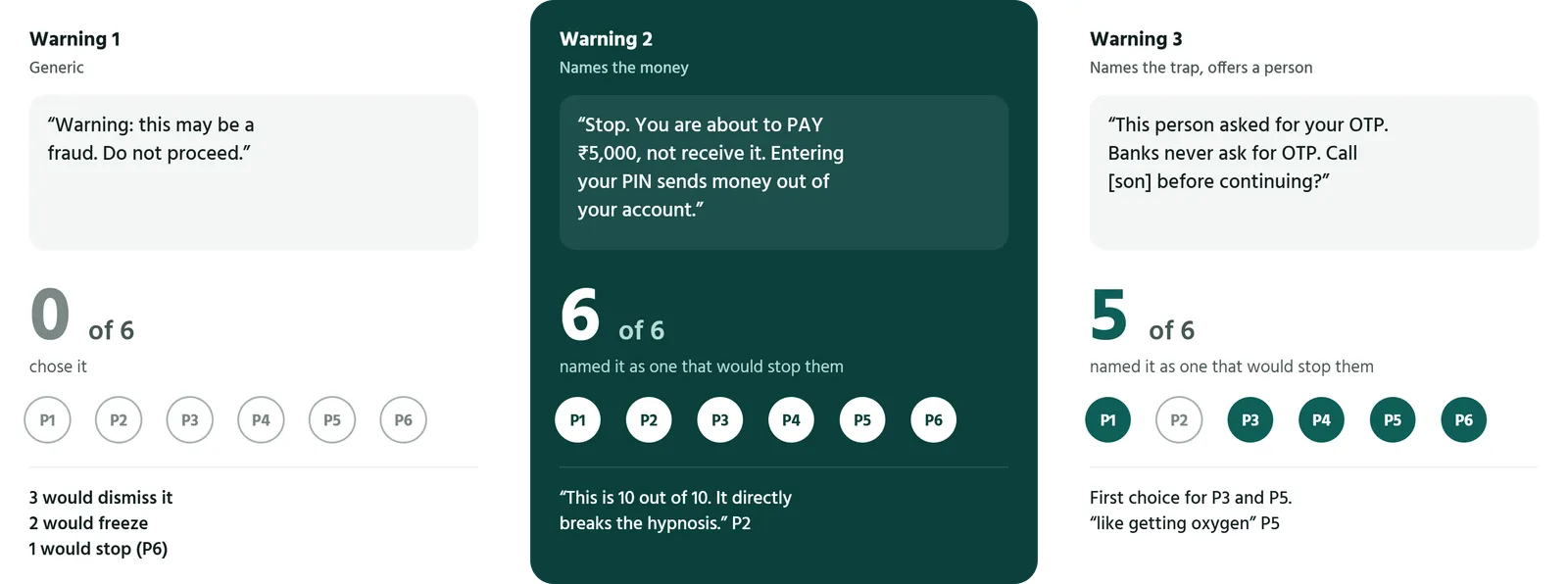
| Warning | Wording | Named it | Reactions |
|---|---|---|---|
| 1 · Generic | “Warning: this may be a fraud. Do not proceed.” | 0 of 6 | 3 would dismiss it, 2 would freeze, 1 would stop |
| 2 · Names the money | “Stop. You are about to PAY ₹5,000, not receive it.” | 6 of 6 | “This is 10 out of 10. It directly breaks the hypnosis.” (P2) |
| 3 · Names the trap, offers a person | “This person asked for your OTP. Banks never ask for OTP. Call [son] before continuing?” | 5 of 6 | First choice for P3 and P5. “like getting oxygen” (P5) |
Each person heard all three, said what it meant and what they’d do, then said which would stop them. Some named two.
08Insights
Three insights, each heard more than once.
1 · Generic warnings get a reflex, not a reading.
“phones write so many things in English every day… So we get the habit of pressing ‘OK’ without reading deeply.” (P1)
- 0 of 6 chose the generic warning
- 5 of 6 have a habit for clearing pop-ups
- 3 of 6 struggled with English like “proceed”
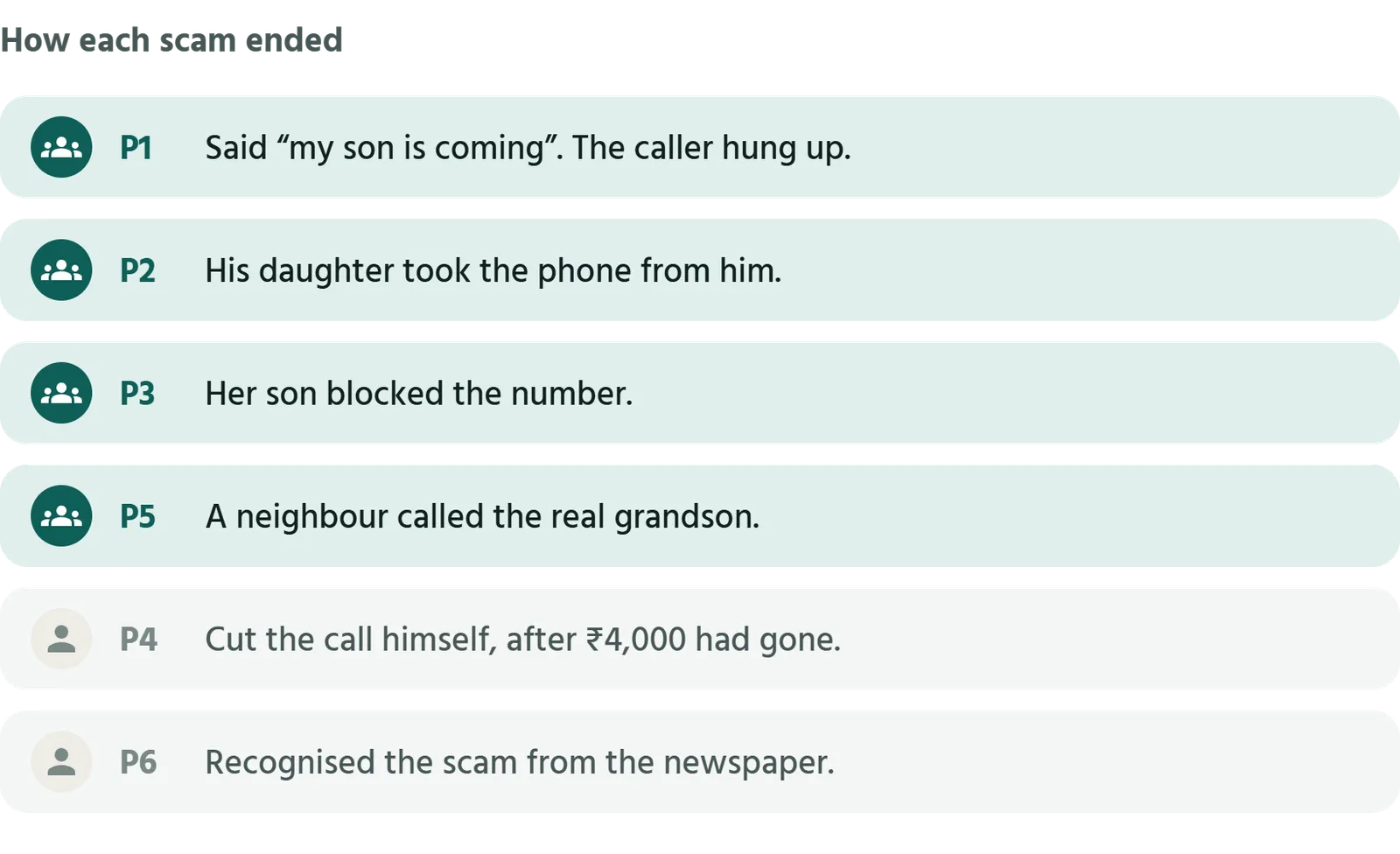
2 · A person, not a pop-up, ended 4 of the 6 scams.
“seeing my grandson’s name on the screen is like getting oxygen. I will press that button immediately.” (P5)
- 4 of 6 scams ended by another person
- 6 of 6 trust family first
- 2 of 6 were told to keep it secret
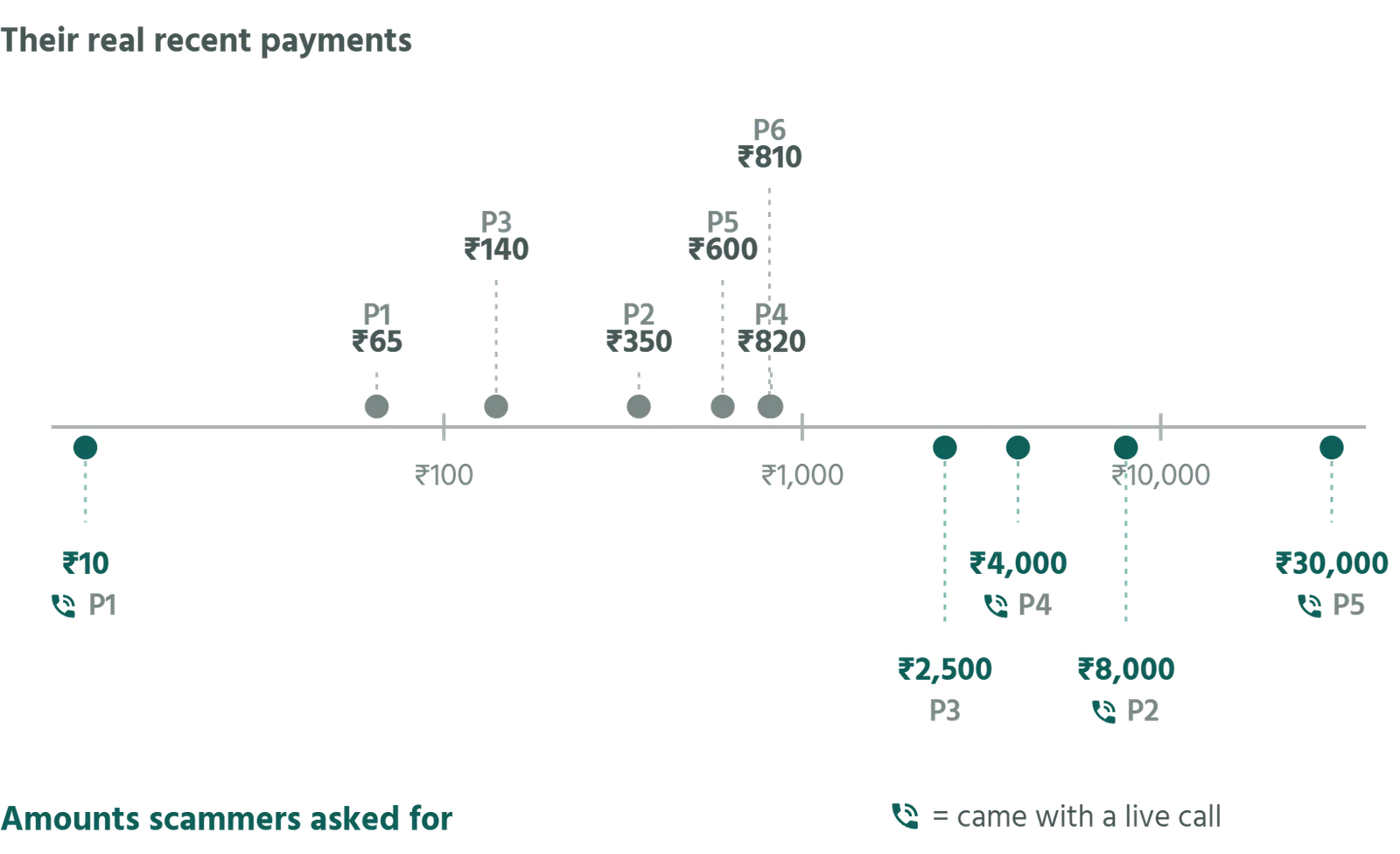
3 · The amount can’t spot a scam. The live call can.
“Never allow a collect request or QR scan from WhatsApp to work while a person is actively on a phone call with an unknown number.” (P2)
- 5 of 6 scams ran over a live phone call
- ₹10, the smallest ask, was below any real recent payment
- 3 of 6 don’t want checks on routine payments
09Design principles
Three rules every warning screen had to pass.
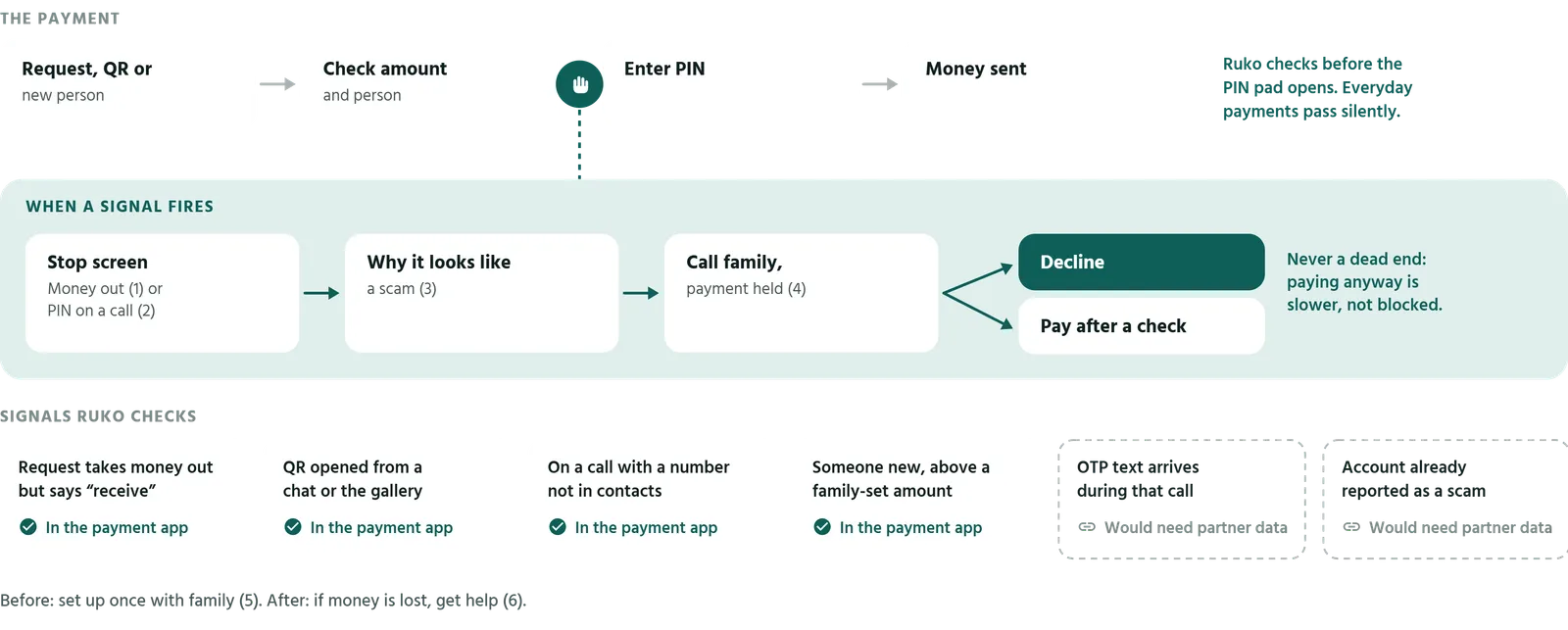
Say what will happen to the money, in their words.
“PAY ₹5,000, not receive it.” In Hindi, and read aloud on request.
Offer a person, not just a warning.
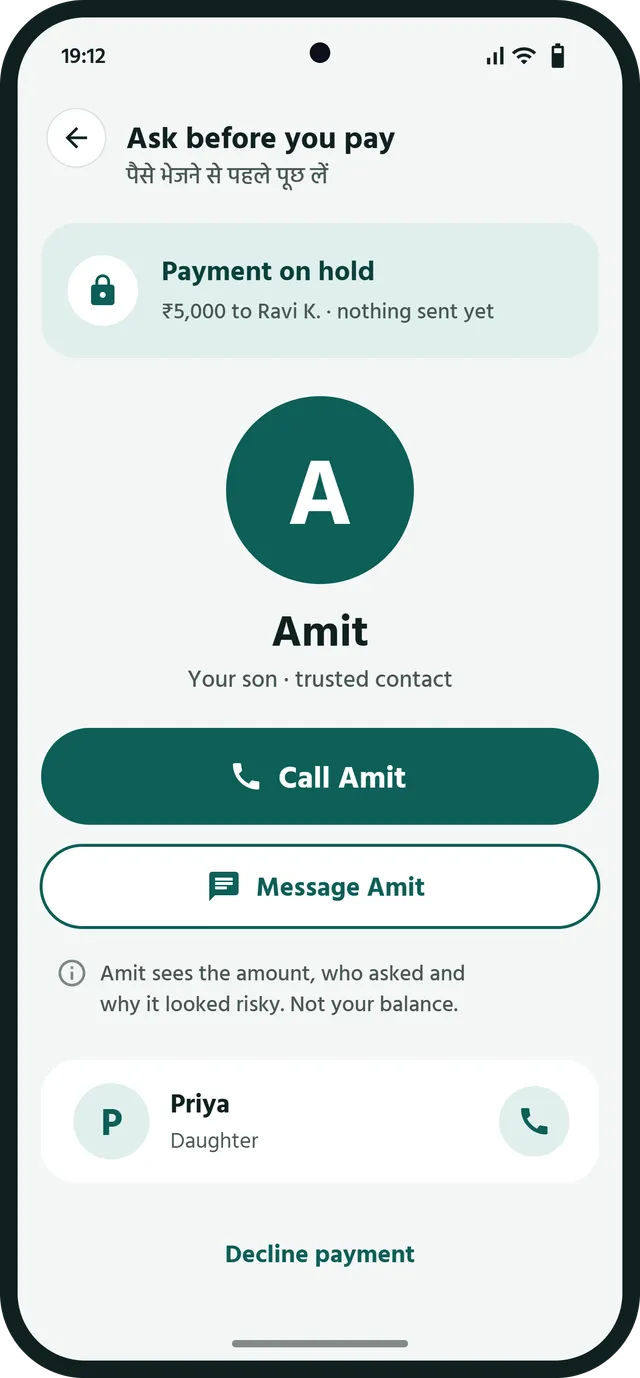
“Call Amit first”, by name, while the payment waits.
Step in at the risky moment only.
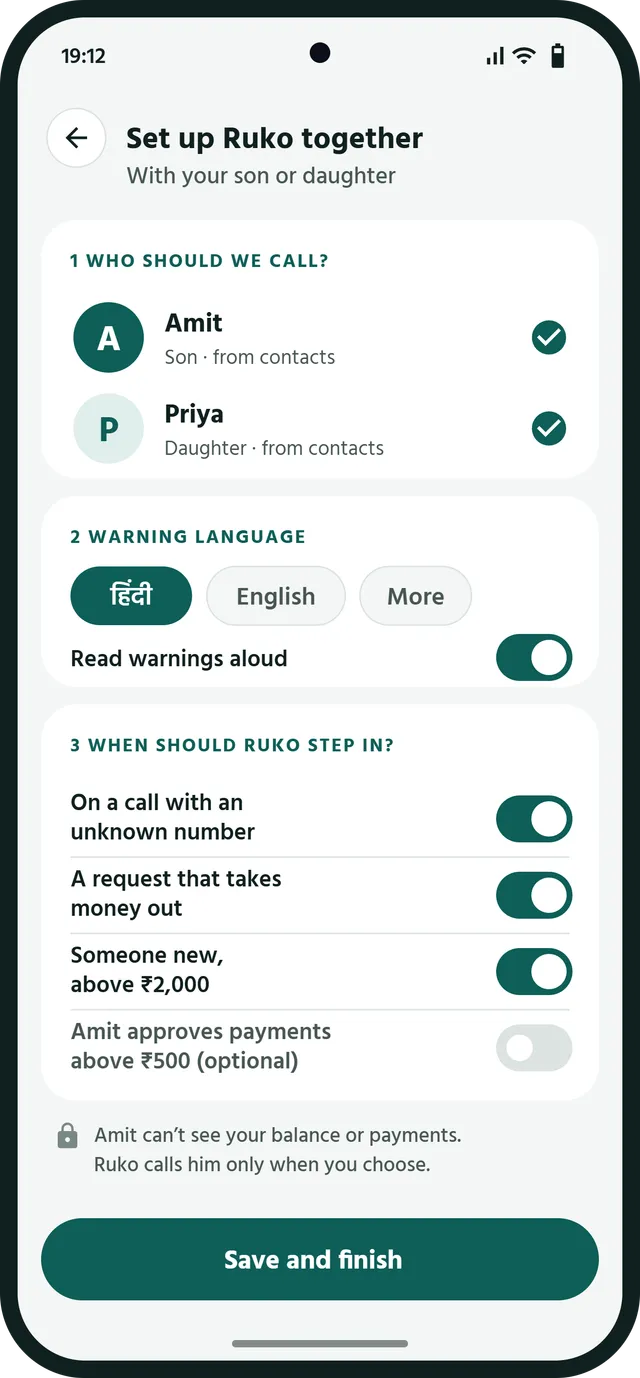
On a call with an unknown number, yes. On the ₹65 ironing bill, never.
A bottom sheet looked like every other pop-up. A full-screen stop won.
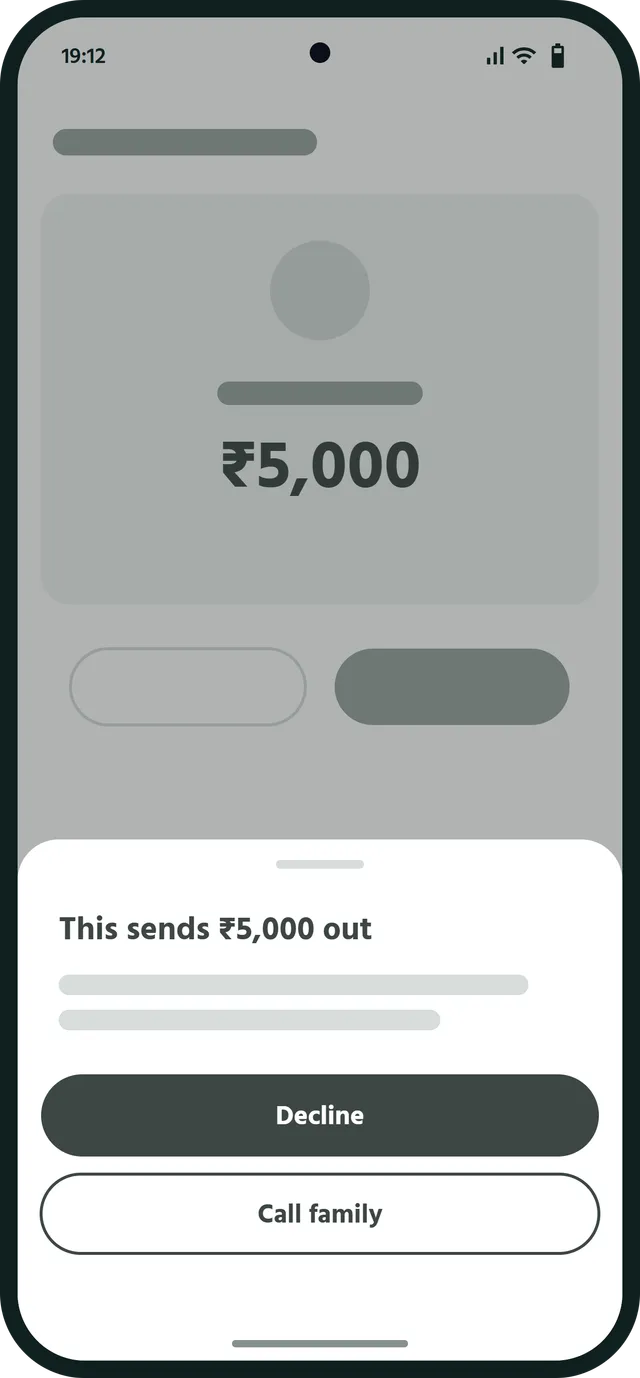
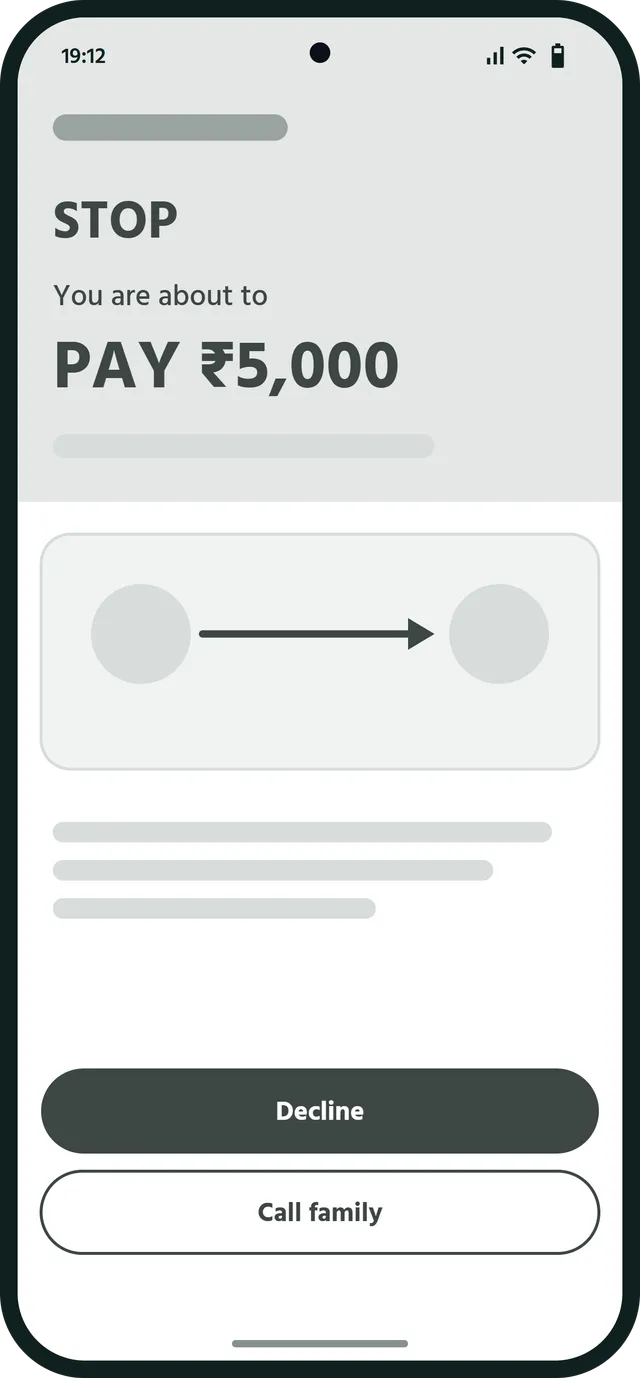
- P2: “if it looks like an advertisement banner at the top or bottom of the screen, my eyes skip right over it.”
- P3 panics over “which button is safe?” One screen, one safe button.
- Full screen only for the stop moment, so it never becomes wallpaper.
10Final design
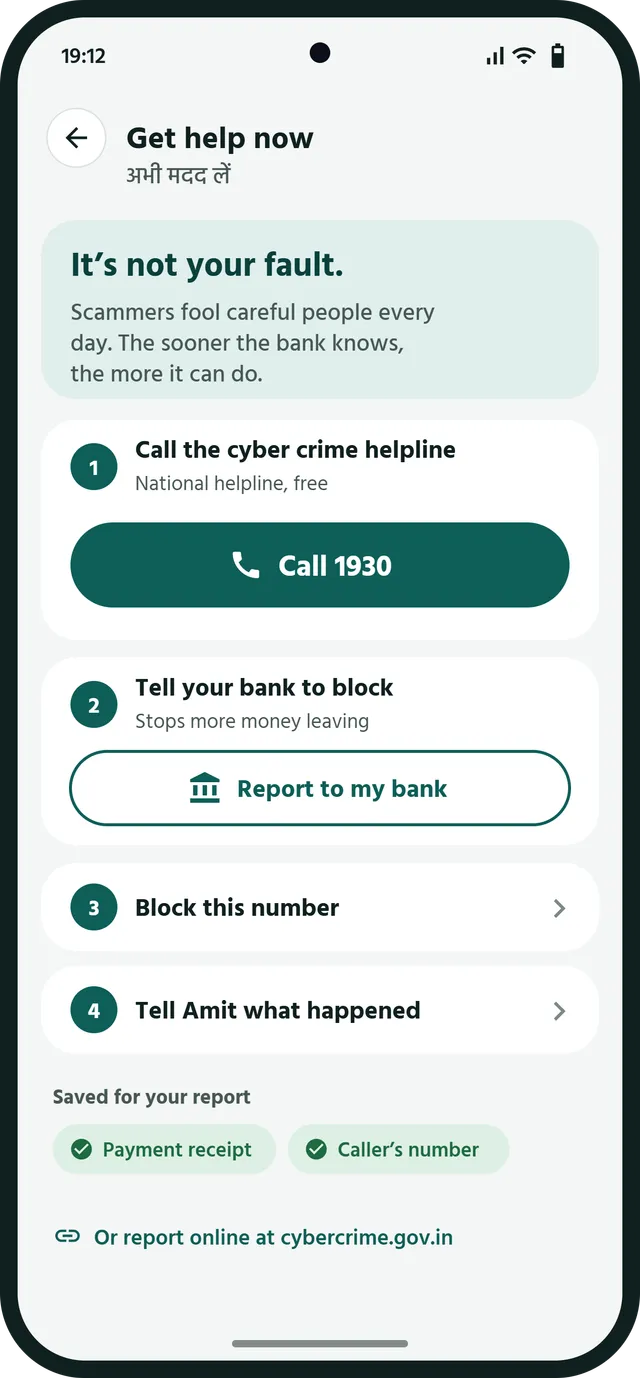
Name the money. Explain in their language. Hand them a person.
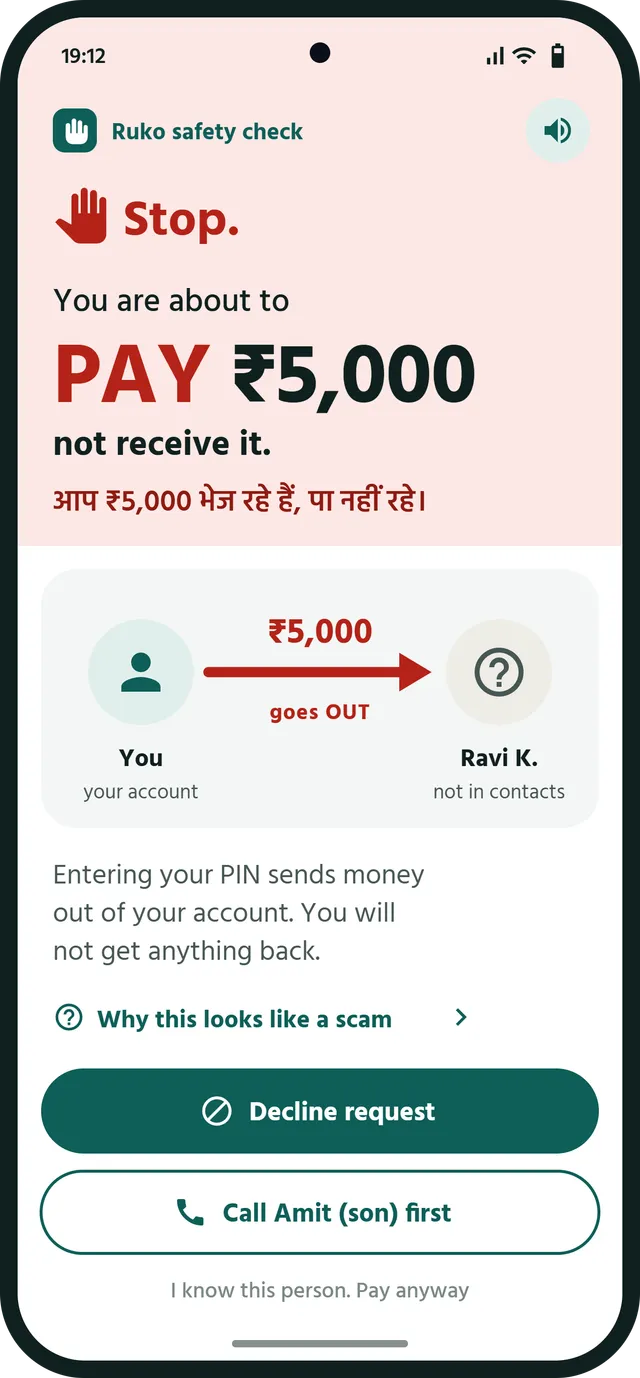
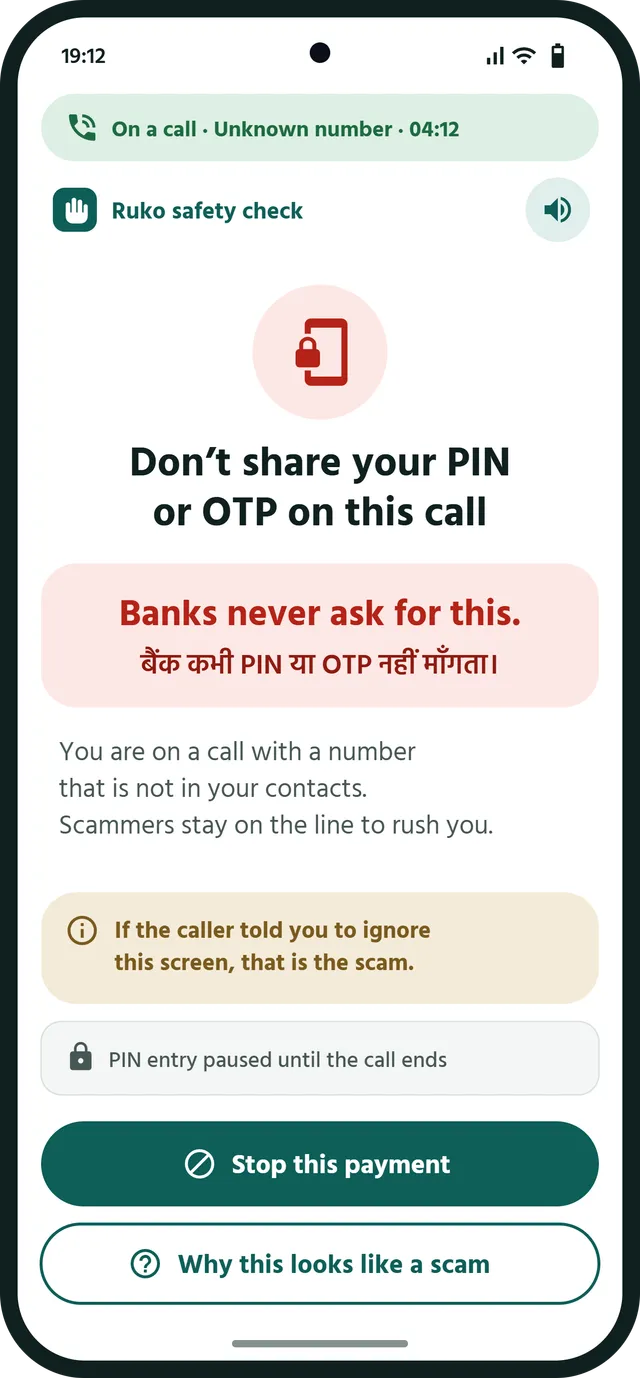
Names and amounts in the screens are samples.
11Research to design
Research turned a pop-up people tap past into a stop they read.
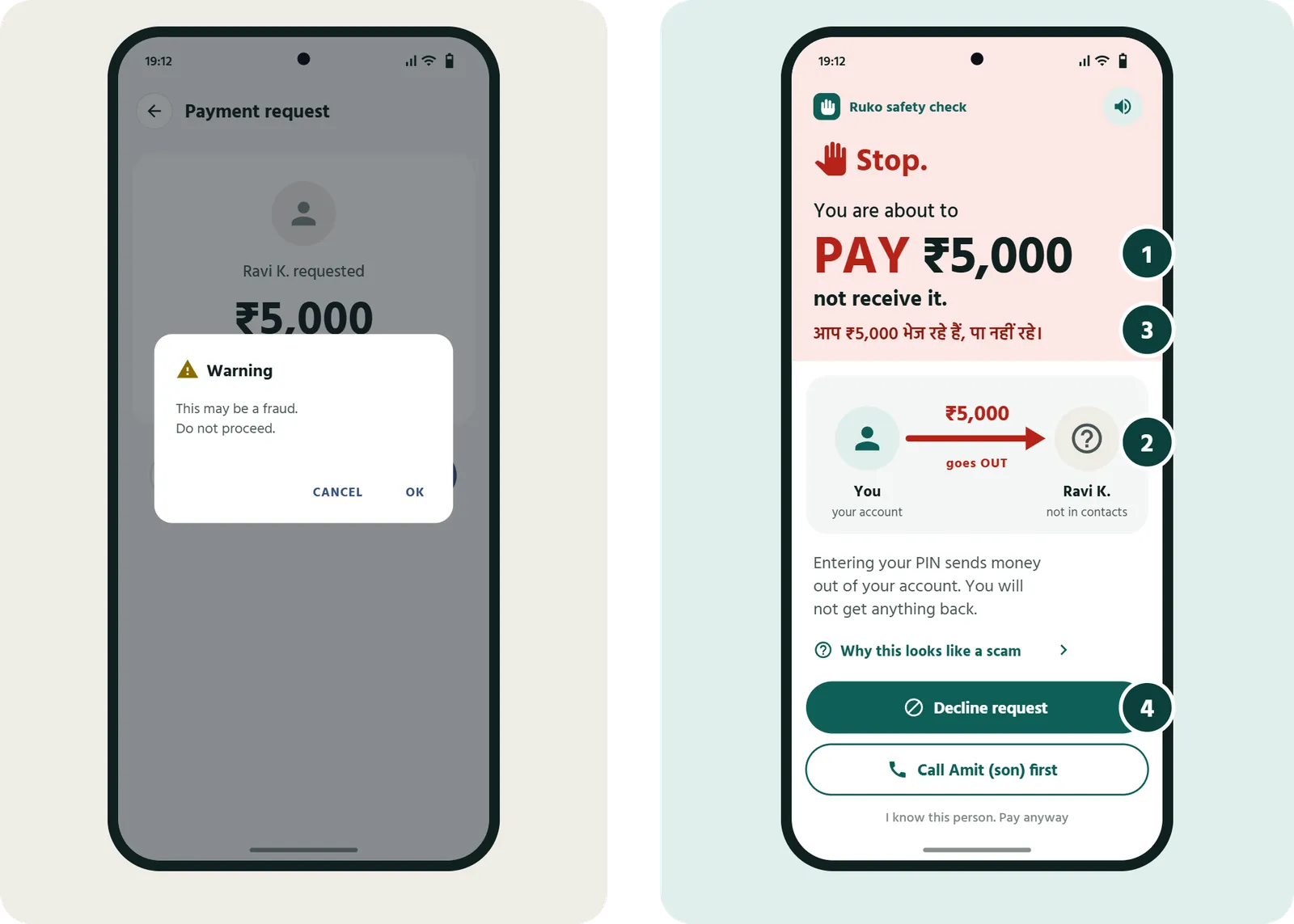
- The money and its direction come first. “Number 2 tells me the exact rupee amount going out.” (P1)
- An arrow, not a word like “proceed”. 2 of 6 stumbled on “proceed”.
- Their language, spoken aloud. Asked for by P1 and P5.
- One safe main button, and a person. The generic warning “just scares you without telling you what to do next.” (P5)
12Measuring success
Success is scams stopped, not warnings shown.
| What I’d measure | How | Signal of success |
|---|---|---|
| Risky payments stopped | Share of warned payments declined or checked with family | High, and holding |
| False-alarm rate | Share of warnings on payments confirmed as genuine | Low, and falling |
| Family call-through | Share of stop screens where the trusted person is called | Rising after setup |
| Losses after “pay anyway” | Reports to the bank or 1930 after a warned payment went ahead | Close to zero |
If Ruko fires on the ₹65 ironing bill, it becomes one more “storage full” pop-up, and the real stop gets tapped away too. Every false alarm spends trust the next warning needs.
Never block people from their own money without a way forward.
13Next and learnings
Next: test the stop screen with people outside my family.
Usability test with 5 people aged 45+.
Spot a “receive” request that pays out, call family from the stop screen, recover after a scam.
Recruit beyond family.
Other cities and languages, and people who have lost money.
Check feasibility with a bank.
The OTP-during-a-call and reported-account signals need partner data.
What I learned: designing for people unlike me meant borrowing their words and their trust. The best copy in this project is “paise kat jayenge” (money will be cut from your account), and the best button is a son’s name.
Next folder / B 003
Berth →
The one answer a train traveller needs right now: where to stand, and when to wake.